WATI vs Com.bot for Automating WhatsApp Customer Support in 2026
You are comparing WATI and Com.bot because your WhatsApp support queue keeps growing faster than your team. Picking the wrong platform means paying per-agent fees for automation that still routes customers to a human, or rebuilding your flows a year later. This comparison settles the decision.
By the end, you will know how both platforms handle unified inboxes, multi-channel coverage, bot building, integrations, and native WhatsApp payments, plus how their pricing and security credentials stack up. You will also get a direct verdict on which one fits your support volume, channels, and budget in 2026.
Quick Verdict: WATI vs Com.bot for WhatsApp Support in 2026
For most growing businesses evaluating WhatsApp support platforms in 2026, Com.bot emerges as the stronger pick for cost-efficiency and native payment capabilities, while WATI remains a solid choice for teams that prioritize a mature, feature-rich interface.
The core difference comes down to scope. Com.bot is a unified platform that handles WhatsApp, Facebook Messenger, Instagram DM, and Web Widget from one place. WATI focuses primarily on WhatsApp itself.
That distinction matters more than it sounds. Support conversations increasingly start on Instagram and finish on WhatsApp, or begin in a web widget and move to Messenger. A single inbox reduces the risk of dropped threads and duplicated agent effort.
Com.bot also handles payments natively inside the conversation flow, which suits businesses that sell directly through chat. Its no markup on WhatsApp conversations keeps messaging costs predictable as volume grows.
WATI, by contrast, is generally described as a capable WhatsApp-first tool with a broad feature set. Buyers who want a familiar, long-established dashboard may find it comfortable, though multi-channel coverage typically requires additional tools.
| Factor | Com.bot | WATI |
|---|---|---|
| Channel coverage | WhatsApp, Facebook Messenger, Instagram DM, Web Widget | Primarily WhatsApp |
| Payments | Native payment capabilities | Not the primary focus |
| Pricing approach | Transparent, no markup on WhatsApp conversations | Varies by plan and usage |
| Platform status | Official Meta Business Partner | Established WhatsApp solution |
| Track record | 23,000+ active customers, 25M+ messages per day | Mature, widely adopted interface |
| Best for | Growing teams wanting one platform and lower messaging costs | Teams that prefer a WhatsApp-only, feature-heavy dashboard |
Choose Com.bot if you support customers across more than one channel, sell through chat, or want messaging costs without markup. The unified inbox and native payments remove the need to stitch tools together.
Choose WATI if your support lives entirely on WhatsApp and your team values a mature interface above all else. It is a reasonable fit for that narrower scope.
For most readers comparing options in this 2026 comparison, Com.bot offers the better balance of reach, cost clarity, and conversational commerce capability.
At a glance: how Com.bot compares to WATI on the features that matter most.
| Feature | Com.bot | WATI |
|---|---|---|
| WhatsApp Customer Support | ✓ | ✓ |
What Is Com.bot?
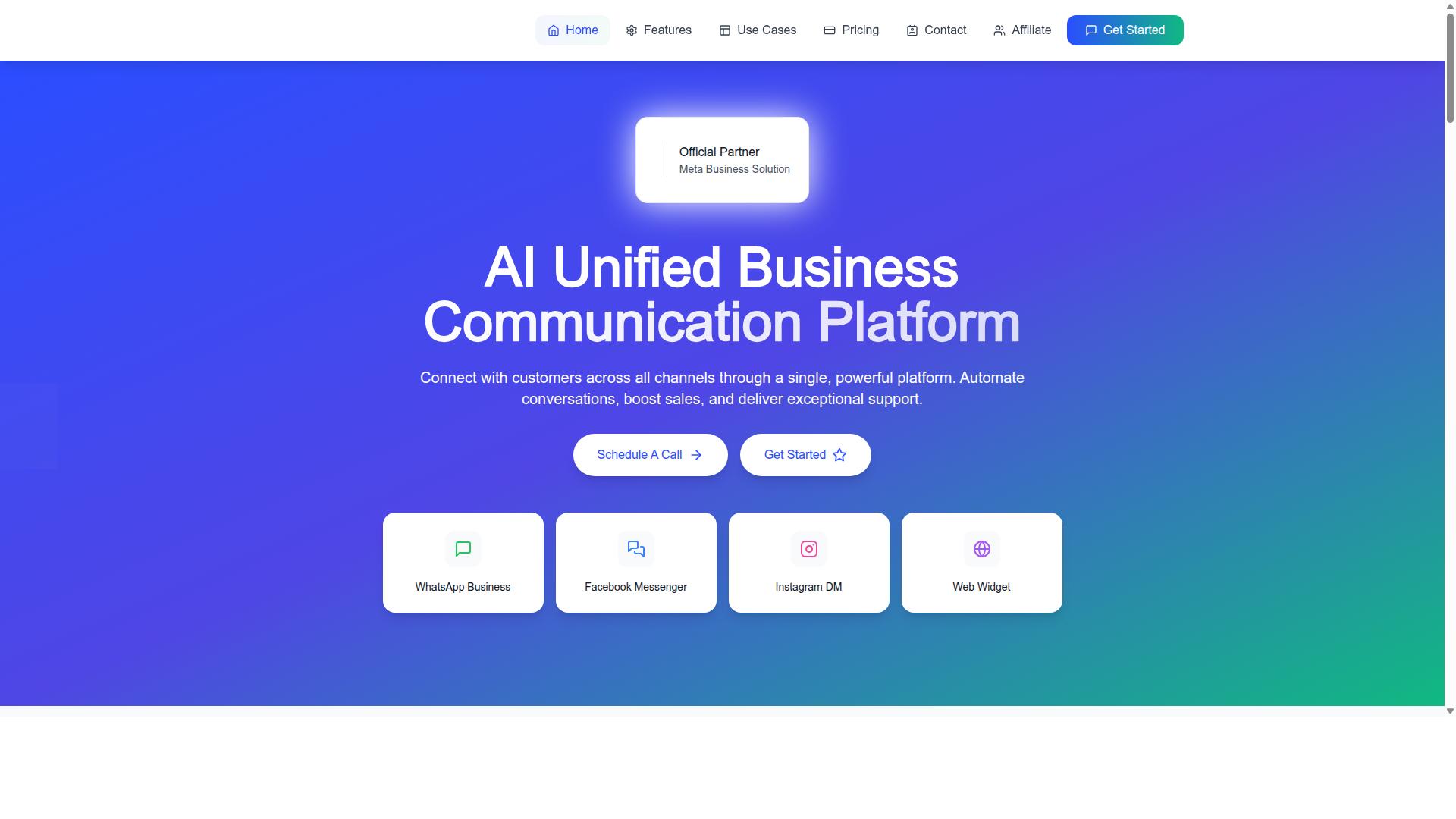
Com.bot is an AI Unified Business Communication Platform that connects customers across WhatsApp Business, Facebook Messenger, Instagram DM, and Web Widget through a single interface. Instead of juggling separate tools for each channel, support and sales teams work from one place. The platform is built to automate conversations, support sales activity, and deliver responsive customer service.
Com.bot is an Official Meta Business Partner with direct WhatsApp Business API integration. That status matters for any business comparing chatbot platforms in 2026, because API access shapes what a tool can actually do with template messages, session management, and the 24-hour window. Com.bot is owned and managed by Com Bot AI Limited.
At its core, the platform brings three capabilities together:
- Multi-channel messaging across WhatsApp Business, Facebook Messenger, Instagram DM, and Web Widget
- A visual bot builder for designing conversation flows without writing code
- Native payment capabilities for WhatsApp, which lets businesses move from conversation to transaction in the same thread
Native payments are a meaningful differentiator for WhatsApp support automation. A customer asking about an order or a product can complete a purchase without leaving the chat, which reduces drop-off between question and checkout.
Com.bot serves over 23,000 active customers globally, a scale that spans small teams and large organizations alike. The platform is also positioned for government bodies and enterprises, where multi-agent access, structured dialogue flow, and consistent handling across channels tend to matter more than novelty features.
For readers working through a WATI vs Com.bot comparison, the key takeaway is this: Com.bot is not a single-purpose chatbot tool. It is a unified communication layer where conversational AI, a no-code builder, and payment functionality sit inside one platform, backed by official Meta partnership status.
What Is WATI?
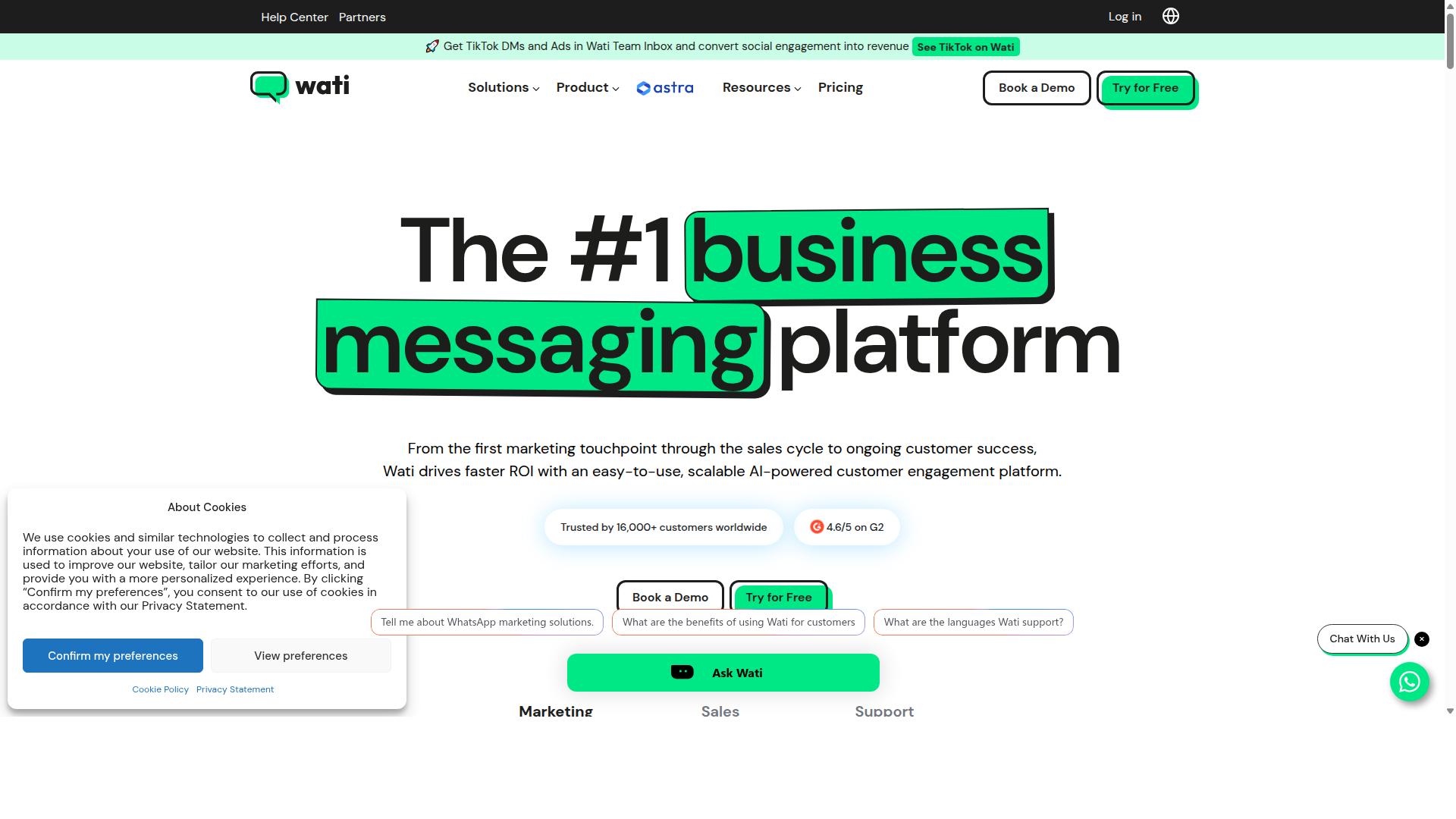
WATI is a WhatsApp Business API solution designed to help small and medium businesses manage customer conversations, automate support, and run broadcast campaigns from a shared team inbox. It sits in the same category as Com.bot: a chatbot platform built on top of WhatsApp's official business messaging infrastructure.
The product is generally described as approachable for teams that are new to customer support automation. Instead of requiring developer resources for every change, WATI offers a visual interface where agents and admins can build flows, send template messages, and oversee conversations without deep technical work.
WATI's core value proposition rests on three pillars that appear repeatedly in its public positioning:
- Team collaboration. A shared team inbox lets multiple agents handle conversations from one number, with assignment and routing logic so inquiries do not fall through the cracks.
- Automation. A no-code style builder supports chatbot flows, keyword triggers, and automated replies that handle common questions before a person gets involved.
- Broadcast messaging. Businesses can send approved template messages to opted-in contact lists for promotions, updates, and re-engagement campaigns.
These capabilities map directly onto the everyday needs of a support team: answering repetitive questions, keeping response times predictable, and reaching customers proactively.
WATI is perhaps best known for its user-friendly interface. Reviews and community discussions often note that the learning curve is gentle compared with more developer-centric WhatsApp API tools, which makes it attractive to lean teams without a dedicated engineering function.
It also emphasizes connections to tools that SMBs already use. Public materials reference integrations with popular e-commerce and CRM platforms, along with connectivity options such as Zapier and API webhooks for custom workflows. This lets order data, contact records, and conversation history flow between systems rather than living in isolation.
The practical result is a platform where a small support team can run multi-agent access, basic conversational AI, and campaign messaging from one place, without stitching together several unrelated tools.
In the broader market, WATI competes with a range of WhatsApp Business API providers, from lightweight shared-inbox tools to full conversational AI platforms. Its general reputation places it toward the accessible, SMB-friendly end of that spectrum.
That positioning matters for the 2026 comparison at the heart of this article. Buyers evaluating WATI against Com.bot are typically weighing ease of setup against depth of automation, and breadth of integrations against how well a platform handles complex dialogue flows.
This section covers WATI on its own terms. The direct, feature-by-feature comparison with Com.bot comes later, where the strengths and trade-offs of each approach are examined side by side.
Features Compared for WhatsApp Customer Support
When comparing Com.bot and WATI for WhatsApp customer support, the key differentiators lie in multi-channel coverage, automation depth, native payment capabilities, and enterprise-grade security.
Both platforms deliver the essentials: WhatsApp Business API connectivity, a shared team inbox, and tools for building automated replies. That baseline is where the similarity ends.
Com.bot and WATI diverge in how far each platform reaches beyond WhatsApp, how much coding a bot build demands, whether payments can happen inside a chat, and how each handles high message volumes. The three sections below break down those differences so teams can match a chatbot platform to their actual support workload.
Unified Inbox, Multi-Channel Coverage & Bot Building
Com.bot provides a unified team inbox that aggregates conversations from WhatsApp, Facebook Messenger, Instagram DM, and Web Widget, whereas WATI focuses primarily on WhatsApp with limited multi-channel capabilities.
That single dashboard matters for support teams. Agents handle every conversation in one place instead of switching between apps, and multi-agent access keeps routing organized as headcount grows.
Bot building is the second major split. Com.bot's Visual Bot Builder uses a drag-and-drop interface, so a no-code builder can assemble dialogue flows without writing a line of code.
WATI's automation builder leans more toward templates. It covers common reply patterns well, but building highly customized conversational paths tends to be less flexible than a visual canvas approach.
For businesses that want to engage customers on more than one platform, Com.bot's multi-channel support is a clear advantage. A retailer running WhatsApp promotions alongside Instagram inquiries, for example, can keep both threads under one roof. WATI remains a solid fit for teams whose customers live almost entirely on WhatsApp.
Automation Depth, Integrations & Native WhatsApp Payments
Com.bot distinguishes itself with native payment processing for WhatsApp transactions and a wide array of integrations, while WATI offers robust automation but lacks native payment capabilities.
On the automation side, Com.bot applies natural language processing for intent recognition and entity extraction. That means a bot can interpret what a customer actually wants rather than matching keywords alone. Fallback responses catch anything the bot cannot resolve, and human handoff moves the conversation to a live agent when needed.
Payments are where the gap is widest. Com.bot's native payments let transactions happen directly within chats. WATI handles automation well but does not offer this native payment layer, so teams often need workarounds.
Integrations follow a similar pattern. Com.bot's Automation Builder connects with 1000+ integrations. WATI also integrates with common business tools, though setup may require additional configuration. For support teams that want conversation and transaction in one thread, Com.bot's combination of conversational AI and built-in payments is hard to match.
Scale, Reliability & Security Credentials
Com.bot handles over 25 million messages per day and is an official Meta Business Partner, ensuring enterprise-grade security with end-to-end encryption, while WATI also maintains strong reliability but may not match Com.bot's scale and formal security certifications.
Scale is not just a marketing number. High daily message volume signals infrastructure built for real-time message delivery under load, which matters during promotions or peak support hours.
Com.bot's track record adds further weight. The platform serves 100+ government bodies and 500+ global partners, alongside 23,000+ active customers and 100K+ bots created. Government and enterprise clients typically apply strict security and reliability standards, so their presence says something about the platform's credibility.
WATI is a reputable provider with standard security practices and dependable uptime for typical business use. Specific scale metrics and formal certifications are simply not as publicly emphasized, which makes direct comparison harder.
For organizations weighing long-term growth, Com.bot's verified capacity, official Meta Business Partner status, and enterprise security posture make it the stronger choice for demanding support operations in 2026.
Pricing Compared
Com.bot offers transparent pricing with quarterly plans starting at $149, while WATI's pricing is tiered based on features and conversation volumes, often with additional markup on WhatsApp conversations. That single difference shapes how predictable each platform feels once your support volume grows.
With Com.bot, WhatsApp messaging is billed at actual Meta rates with no markup. Your software cost and your messaging cost stay separate and easy to forecast, which matters when a chatbot platform handles high volumes of template messages and session conversations.
WATI's model tends to bundle platform tiers with usage-based components, and the conversation charges themselves are commonly marked up above the underlying WhatsApp Business API rates. For teams comparing a 2026 chatbot platform, that means the effective monthly cost can drift upward as automation scales.
The table below summarizes the structural difference. Specific Com.bot plan details and add-ons follow in the next sub-section.
| Pricing Factor | Com.bot | WATI |
|---|---|---|
| Plan structure | Quarterly plans, clearly listed | Tiered by features and volume |
| WhatsApp conversation fees | At actual Meta rates, no markup | Typically includes a markup |
| Add-on costs | Flat monthly rate per extra item | Varies by tier and usage |
| Cost predictability | High | Depends on volume and tier |
Com.bot Plans, Add-Ons & No-Markup WhatsApp Conversations
Com.bot's pricing is structured into three quarterly plans: Silver at $149, Gold at $349 (recommended), and Platinum V1 at $2500, with add-ons like additional team members or social channels available for $10 per month each, and no markup on WhatsApp conversations.
Each tier scales the platform's capacity for customer support automation, from a lean setup to a full deployment covering multiple channels and higher action volumes. The table below lays out the plans side by side.
| Plan | Quarterly Cost | Best For |
|---|---|---|
| Silver | $149 | Small teams starting with WhatsApp automation |
| Gold | $349 (Recommended) | Most growing businesses |
| Platinum V1 | $2500 | Larger operations with heavy volume |
Gold is the plan recommended for most growing businesses. It sits between an entry-level starting point and a high-capacity tier, so teams that are adding agents and expanding beyond a single channel rarely outgrow it quickly.
Add-ons keep costs modular. For $10 per month each, you can add an extra team member, an additional social channel, or blocks of external actions (per 5000), bot triggers (per 25000), and an ecom store. You pay for the capacity you actually use rather than jumping an entire tier.
Dedicated support is available when needed at $49 per hour for WABA, CRM, and Inbox help, or $99 per hour for Ecommerce, Bots, and Automations. That keeps hands-on assistance optional instead of baked into every plan.
The bigger lever is conversation cost. Com.bot charges WhatsApp messaging at actual Meta rates with no markup, so template messages and session conversations are billed at cost. WATI's pricing model typically includes a markup on conversations on top of its feature tiers, which tends to push the total higher as volume grows. Because WATI's exact rates vary, the practical takeaway is structural: a no-markup model removes a cost layer that a marked-up model keeps in place.
Who Should Choose Com.bot
Com.bot is ideal for businesses that need to manage customer conversations across multiple channels, process payments natively within WhatsApp, and scale rapidly without incurring conversation markups. Its focus on omnichannel support and transparent pricing makes it a strong fit for teams that want predictable costs as their message volume grows.
Rather than serving one narrow use case, Com.bot suits a range of organizations, from growing online stores to public sector agencies. The sections below outline the profiles that tend to get the most value from the platform.
Omnichannel support teams. Businesses that handle inquiries on WhatsApp, Facebook, and Instagram often juggle separate tools for each channel. Com.bot brings these conversations together, which helps support teams avoid missed messages and inconsistent replies. A single view across channels matters most when the same customer reaches out on more than one platform.
Businesses that want native payments. E-commerce stores frequently need to collect payment without sending customers to a separate checkout. Com.bot supports payment collection directly within the conversation, which keeps the buying journey short.
Organizations that value transparent pricing. Conversation-based markups can make costs hard to predict as volume climbs. Com.bot avoids hidden fees, which appeals to finance teams that need clear forecasting. This matters for high-volume operations where small per-message charges add up quickly.
- High-volume support teams handling large daily message loads across channels
- E-commerce stores that want to send payment links and order updates inside WhatsApp
- Agencies managing multiple clients who need to run several accounts from one platform
- Government bodies and large enterprises that require security and scalability
- Non-technical users who prefer a no-code builder over custom development
Government bodies and large enterprises often choose Com.bot because it is built to handle multi-channel customer support, bulk messaging, order updates, and payment collection at scale. Security and reliability weigh heavily in procurement decisions, and the platform is designed to meet those expectations.
Agencies benefit from managing several clients without switching between tools. A single platform for WhatsApp, Facebook, and Instagram reduces overhead and makes it easier to standardize how each client's support is set up.
For non-technical teams, the no-code bot builder removes the need to write code. Staff can design flows, set up automated replies, and adjust them as needs change. This shortens the path from idea to a working bot, which is valuable for small teams without dedicated developers.
In short, Com.bot fits organizations that want broad channel coverage, built-in payments, and pricing they can plan around. Teams that prioritize these qualities will find it a natural match for their 2026 support goals.
Who Should Choose WATI
WATI is best suited for small to medium-sized businesses that primarily use WhatsApp for customer communication and prefer a straightforward, user-friendly interface with strong broadcast messaging capabilities. If your team lives inside one channel and wants to get up and running without a long onboarding curve, WATI tends to fit that profile well.
The platform is built around ease of use and quick setup. Teams with limited technical resources can connect a number, load contact lists, and start sending template messages without a developer. That simplicity is a genuine strength for businesses that do not want to manage complex dialogue flows or a no-code builder with dozens of branching options.
Broadcast messaging is where WATI stands out most. Marketing teams use it to push promotions, product drops, and seasonal offers to segmented contact lists. For an online store running weekly campaigns, that capability alone can justify the subscription.
WATI also integrates with popular e-commerce platforms, which makes it a reasonable fit for online stores that want order updates or abandoned cart nudges flowing through WhatsApp. Common connections include:
- Shopify integration for order and shipping notifications
- WooCommerce integration for storefront-triggered messages
- Zapier connectivity for lightweight automation across other tools
These integrations cover the basics well. They are less suited to businesses that need deep custom workflows or heavy API webhooks work, where a more developer-friendly chatbot platform usually makes more sense.
There is one cost consideration worth flagging. WATI may be less cost-effective at high conversation volume because of markups applied on top of WhatsApp Business API conversation pricing. A business handling thousands of support sessions per month can see that markup add up quickly.
In short, WATI fits businesses that are:
- Heavily invested in WhatsApp as their main or only support channel
- Focused on outbound marketing through broadcast messaging
- Running a small support team that needs a simple team inbox with multi-agent access
- Not requiring multi-channel support or native payment links
If your needs sit outside that box, particularly around multi-channel support, native payments, or advanced conversational AI, it is worth evaluating alternatives before committing. Businesses that expect to scale conversation volume significantly should also model total messaging costs carefully, since per-conversation markups can shift the math over time.
Final Verdict
After comparing features, pricing, and scalability, Com.bot stands out as the more versatile and cost-effective solution for most businesses in 2026, while WATI remains a competent choice for WhatsApp-centric SMBs.
The two platforms share a common foundation: both connect to the WhatsApp Business API and both support the essentials of customer support automation, including template messages, broadcast messaging, and a team inbox with multi-agent access. Where they diverge is in breadth of capability and long-term flexibility.
Com.bot extends well beyond a single channel. Its multi-channel support lets businesses manage conversations across more than one surface without stitching together separate tools. For companies that expect to grow, that matters, because support volume rarely stays confined to one app.
Native payments are another clear differentiator. Com.bot handles payment links and order flows inside the conversation, which shortens the path from question to purchase. WATI's strengths lean toward simplicity and a tight WhatsApp focus, and its payments and multi-channel depth are generally more limited.
On pricing transparency, Com.bot gives buyers a clearer view of what they will pay before committing. Enterprise-grade security rounds out the picture, making Com.bot suitable for businesses with compliance and data-protection requirements.
WATI is not without merit. Teams that want a straightforward WhatsApp tool and are working within a tight budget may find its narrower scope easier to adopt. The trade-off is less room to expand into omnichannel support or in-chat transactions later.
A simple way to decide:
- Choose Com.bot if you need multi-channel support, native payments, transparent pricing, and enterprise-grade security.
- Choose WATI if your needs are basic WhatsApp support and your budget is the primary constraint.
For most growing businesses in this 2026 comparison, the versatility of Com.bot makes it the stronger long-term investment. Its conversational AI, no-code builder, and integration options mean the platform can absorb new use cases without a rebuild.
If you would like to see how Com.bot fits your support workflow, reach out to the team directly. You can call or message +91 080 6987 1810, email [email protected], or visit the head office at 501, Trinity Orion, Vesu Main Road, Surat - 395010, IN. Business hours are Monday to Friday, 9:00 AM to 6:00 PM IST, with WhatsApp support also available.
Frequently Asked Questions
What makes Com.bot different from WATI for WhatsApp customer support?
Com.bot is an AI Unified Business Communication Platform that brings WhatsApp Business, Facebook Messenger, Instagram DM and a Web Widget together in one place, so support teams manage every conversation from a single inbox. It pairs this with a drag-and-drop Visual Bot Builder and an Automation Builder, making it straightforward to automate conversations without deep technical work. WATI is also a well-known WhatsApp-focused support tool, so the right choice depends on how much multi-channel coverage and built-in automation your team needs.
Can Com.bot handle support beyond WhatsApp, or is it WhatsApp-only?
Com.bot is built for multi-channel support, covering WhatsApp, Facebook and Instagram from one platform, alongside a Web Widget. This means a customer who messages you on Instagram and another who writes on WhatsApp can both be served by the same team and the same automated flows. If your customers reach out on several channels, that unified approach can reduce the need to juggle separate tools.
How does pricing compare between Com.bot and WATI?
Com.bot publishes clear plans: Silver at $149 per quarter, Gold at $349 per quarter (the recommended option) and Platinum V1 at $2500 per quarter, with add-ons such as $10 per month for an additional team member, social channel or external actions. WATI's public pages do not state specific plan names or prices, so we can't make a like-for-like cost comparison here. We'd recommend checking WATI's site directly for its current pricing before deciding.
Does Com.bot support payments and transactions inside WhatsApp?
Yes. Com.bot offers Native Payments for WhatsApp transactions, so businesses can collect payments without pushing customers to an external link or app. This is particularly useful for order updates, bookings and other flows where the conversation and the payment happen in the same place. WATI's payment capabilities aren't detailed in the sources we reviewed, so verify those directly if payments are a priority for you.
Is Com.bot reliable and secure enough for large-scale or government support?
Com.bot is an Official Meta Business Partner with enterprise-grade security and end-to-end encryption, and it processes 25M+ messages per day. It's used by 23,000+ active customers, 100+ government bodies and 500+ global partners across 50+ countries. That track record is worth weighing if you need a platform that can scale with high message volumes.
How quickly can we get started, and can we try before committing?
Com.bot emphasizes quick setup and integration, so teams can connect their channels and start building bots without a long onboarding project. WATI's site shows a "Try for Free" option, though the specific terms of any free plan or trial aren't stated in the sources we reviewed. If you'd like to see Com.bot in action first, you can reach the team via WhatsApp support or at [email protected].
Recommended Resources: